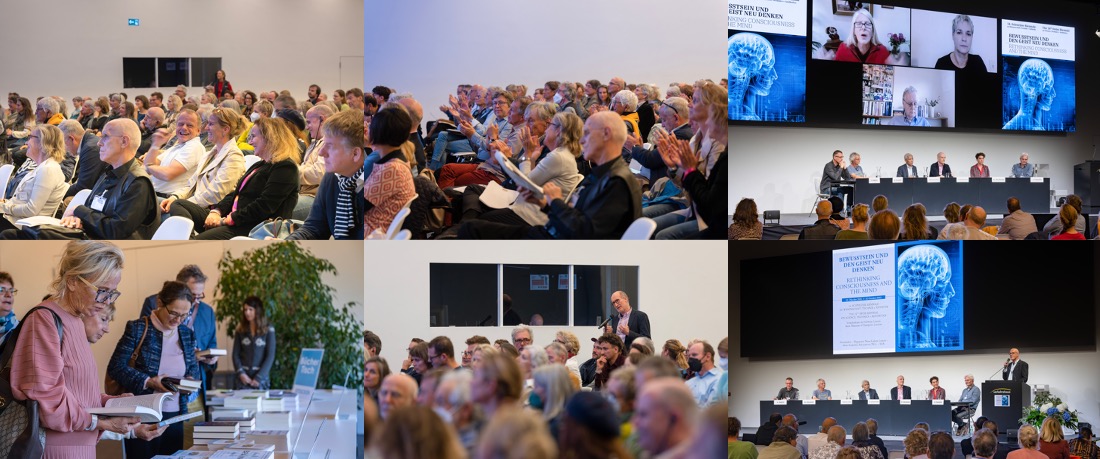
After almost 30 years and 14 Swiss Biennials, we are no longer carrying out any more cultural and scientific projects. Funding has proved increasingly difficult in recent years - in particular after Corona. We very much regret this decision and thank you for your long-term loyalty.
As a final act, we have made the legendary panel discussions and lectures with the later Nobel Prize winners Sir Roger Penrose and Anton Zeilinger in the Lucerne Theatre on the occasion of the 2001 Biennial publicly available as videos (German and English), as well as other contemporary documents (audio lectures). You can watch or listen to them free of charge via this link.
If you have time to write a testimonial about the Biennial (1 -2 sentences), you can send it to us with your first name, surname, place of residence via info at neugalu.ch. We will be happy to publish it here.
With best regards and lots of thanks in advance. René Stettler and the Biennial team
Testimonials
topical
It was an honor to be a partner of the Biennial, this unique scientific event that will be sorely missed. Felix Schenker, art.tv, Zurich
The end of the Biennials is sad news. The Biennials on the Mystery of Human Consciousness were dedicated to one of the great unsolved problems in the fields of science, technology and aesthetics, and regularly contributed new results and interesting insights. Urs von Stockar, Lutry
Thanks for the tireless and wonderful commitment to science and its aesthetics. Aesthetics is the mother of ethics, and without the commitment of the Biennial there is now a gap. The Biennial has understood and taken seriously the sentence "The highest beauty of human nature consists in the splendor of science" by Thomas Aquinas.
Ernst Peter Fischer, Heidelberg
It's a great pity that the Biennial will no longer take place. I particularly remember the lecture on quantum physics by Hans-Peter Dürr. But I also remember what I learned about the rhythmic communication of whales at one of the Biennials. Lots of thanks for the many great experiences that the Biennials have made possible. Rudi-Renoir Appoldt, Lucerne
This Swiss Biennial granted the audience unprecedented access and dialogue with distinguished minds, even though a consensus on consciousness has remained elusive over the decades. Major respect and kudos to the Biennial team for making this possible! Peter Hossfeld, Dübendorf
The end of the Biennial is a great loss in the Swiss/global educational landscape in terms of bridge-building. In view of the current political and ethnic challenges, this may be a minor issue, but in my opinion it is precisely such events that create understanding, common ground and inner upliftment.
Diego Hangartner, Zurich
We can't believe that the Biennial is now apparently a thing of the past. We thank you from the bottom of our hearts that something as great as the Biennial took place in Lucerne. Our participation will be absolutely unforgettable. Eva Bucher / Daniel Stangl, Meggen
For a musician “all things change” is pretty much self-evident. Frozen sound is unthinkable (regardless of the passage in ‘Gargantua & Pantagruel’). Nevertheless, the Biennials in Lucerne were a wonderful offering to the world of thought and it’s sad to see their end. Thank you for all your extraordinary work in compiling such a valuable resource! Anthony Moore, Köln
The Swiss Biennial was a great event and always a special highlight of my working year when I was able to come to Lucerne as an interpreter for many years. Eva Fürthauer, Vienna
Participating in the Biennial was always a joyously eclectic affair. One rubs shoulders with scholars, scientists, mystics, philosophers and other practitioners of magic. Such intellectual mixes are rare and important affairs.
Margaret Wertheim, Los Angeles
A powerful concept full of heart and inspiration. I'm sorry to see it have to rest due to monetary issues. Jennifer Kanary Nikolova, Wormerveer / Netherlands
I would like to thank you from the bottom of my heart for your great commitment over the years. The Swiss Biennial has always been an incomparable experience for me. It was associated with great anticipation and expectations that were not disappointed but exceeded. Not only the high-caliber contributions, but also the encounters with the participants were an enrichment for which I am grateful. Anja Kroll, Lenzburg
Thank you for all the great years we have had the pleasure of hosting the Biennial and its speakers. Igor Simic, Hotel Rebstock Lucerne
The Swiss Biennial was a unique, pioneering achievement. As far as I know, there has never been an event of this kind anywhere else for so many years. For me, my interpreting assignment was always a challenge and a highlight, and we have many fond memories of Lucerne. The collaboration over the years has been great. Ingrid Kurz, Vienna
The Biennial has done a great job! The recordings and publications are a wonderful legacy. Thank you for your commitment!
Elisabeth Walcher, Salzburg
I would like to thank the Biennial for all the inspiration and work it has done for us in Switzerland over the years. Something like this should happen much more often, where scientists and wise people meet and share their insights about human consciousness. It was always simply brilliant, even if I didn't always really understand everything. I watch some congresses online, but unfortunately there are hardly any important personalities like those at the Biennial. Irene Jahn, Oberuzwil
I admire what the Swiss Biennial has achieved over time and repeatedly - world class. Konrad Fischer, Zurich
Central Switzerland is a granite-hard place for truly creative innovations, whether theater, video, fashion, art education or even what the Swiss Biennial has built up and organised. Many thanks, also for the exciting experiences and the intellectual "food" over many years. Gualtiero Guslandi, Lucerne
I would like to thank you from the bottom of my heart for this valuable seed that the Swiss Biennial has given to humanity and education. I am one of many people who greatly appreciated the Biennial in Lucerne. A big loss. Nena Sulser, Winterberg
My sincere thanks for the outstanding work of the Swiss Biennial and all those involved, as well as my energising impulse to hypertransform in order to successfully reinvent the intention of the Biennial in a form that will be financially viable. Bettina Fischer, Rüschlikon
I deeply regret that the Swiss Biennial will no longer take place! The word "consciousness" immediately motivated me to take part. Each time, my anticipation of the exciting topics and speakers was huge. Immersing myself in this interesting world - in the midst of a unifying community - was always a great and lasting experience. Christoph Buser, Gränichen
It is sad and scandalous that the city of Lucerne has failed to recognise the scientific importance of the Biennial and its international appeal: Renowned speakers shared their knowledge in Lucerne for almost 3 decades not only with an interested lay audience, but also among each other. Christina Ljungberg, Meggen
I very much regret the decision to give up the Biennial. Lucerne is losing an event with stature.As photographer of the Swiss Biennial on Science, Technics and Aesthetics, it was a fantastic experience. The opportunity to convey the connection between complex scientific topics and visual aesthetics through my images was extremely enriching. Roberto Conciatori, Lucerne
It's a pity that the Biennial is coming to an end. I was able to experience Fritjof Capra live in 2016, as well as Sir Roger Penrose. That was very impressive. Many thanks for that and all the best, inspiration and energy for new projects. Michael Stutz, Winterthur
I would like to thank you for your many years of great commitment to the Biennial and wish you all the best for the future.
Othmar Käppeli, Würenlos
Thank you for the many years of exceptional and valuable mediation and inspirational work. I have fond memories of numerous, lasting encounters at various Biennials, including the impulses from Fritjof Capra (The Tao of Physics), with comments on his research work on Leonardo da Vinci (Learning from Leonardo), which had a decisive influence on me.
Yvo Wüest, Lucerne
This event was like an old lighthouse for me. Looking out for it and being able to visit it every two years was always enlightening. Even knowing that I would never get to the top of the beacon. It takes a lot of idealism and ultimately money to preserve buildings like this. But how can you sell something if you can't (touch) the most valuable thing in it? The Biennial has done it. Many thanks and all the best! Martin Kilcher-Zhang, Berne
A long and very successful journey comes to an end. Thank you very much for your tireless commitment to a great project. I have always found the Biennials very enriching and special. I wish you all the best and bow down to your achievements.
Roman Wüst, Wilen
Even though I can understand the decision, I regret and mourn it. This outstanding Lucerne event, which took place every two years and allows many areas of the brain to light up, will no longer take place. Thank you for your great work.
Trudi Bacher, Emmenbrücke
older ones
Marcel Perren, Director, Lucerne Tourism AG: "As ambassador of the congress city of Lucerne, we would like to thank René Stettler for his personal commitment to successfully positioning the city of Lucerne as a congress destination". (17.10.2016)
Stefan Roth, former Mayor of Lucerne: "With the Biennial, a fine event has been established in Lucerne that brings positive attention to the name of our city around the globe". (7.11.2014)
Markus Hofmann, Editor at the Neue Zürcher Zeitung: "That's what René Stettler wants: speakers with 'heart and mind'. Stettler demands a new presentation from each of the invited speakers. They should not present something stale from the drawer at the Biennial". "Grosse Fragen in der kleinen Leuchtenstadt" (NZZ, 25.1.2014; Photo Markus Hofmann: NZZ)
Anton Schwingruber, former Cantonal Councillor and Director of Education of the Canton of Lucerne: "The city and canton of Lucerne have gained considerably in importance as a center of education and culture in recent decades. The role of the Biennial is the independent objection, the critical questioning of seemingly stable conditions in science, society, culture and the environment". (4.5.2010)
Urs W. Studer, former Mayor of Lucerne: "Lucerne can be proud to host the Biennial. We particularly appreciate the fact that people with outstanding intellectual abilities find their way to Lucerne thanks to this event". (23.6.2010)
Uli Sigg, Art collector (Sigg Collection): "With the Biennial, cultural mediator René Stettler has achieved a great success. He has created an event that radiates far and wide for Lucerne and fits in very well with Lucerne's desired profile as a university and science city for the humanities". (28.9.2010)
To ask difficult questions about the challenges confronting humanity is a key precondition for learning of how to deal with the future. At the Swiss Biennial, I had the privilege of listening to colleagues from around the world, of learning from them, and of engaging in constructive dialogue. The Biennial wonderfully illustrated (and in a beautiful location at that) how far dialogue can take us when we engage our minds and bodies mentally as well as physically. Marcelo Gleiser, Appleton Professor of Natural Philosophy, Dartmouth College, Hanover, NH - USA
What kind of creatures are we? Pursuing that simple question takes us unexpectedly down the rabbit hole of human nature. We are indeed an enigma to ourselves. The 2018 Swiss Biennial fused insights from the sciences and humanities in an exhilarating exploration of the mystery that is us. Donald D. Hoffman, Cognitive Sciences, University of California, Irvine
The Swiss Biennial 2018 "The Enigma of Human Consciousness" provided a wonderfully open forum in which diverse scientific and contemplative methods and theories were presented for comprehending the nature of consciousness. B. Alan Wallace, Contemplative Sciences and Buddhism, Institute for Consciousness Studies, Santa Barbara, CA
René Stettler has a knack for posing deep, important questions and orchestrating fascinating discussions of them by leading thinkers from around the world. I feel privileged to have contributed to two of the meetings he organised, in 2010 and 2018. John Horgan is an American science journalist best known for his 1996 book The End of Science.
The Swiss Biennial has been one of the best events I've had the privilege to participate in. Everything was just right: the location, the mix of speakers, the program, the associated activities, etc. More importantly than the impeccable organization, the group of people René Stettler put together, including speakers, patrons and audience, was highly synergistic, which enabled very productive and interesting interactions. I've had a great time and look forward to coming back one day. Bernardo Kastrup, Philosopher, Author and Independent Scholar, Veldhoven, NL
René Stettler's vision behind the Swiss Biennial - bringing the best minds from diverse disciplines together in order to explore topics of common interest and concern with the aim to educate the larger public - is both beautiful and noble. It is this distinctive vision, which creates a unique forum where the speakers share their insights - in a way that is lucid. Thupten Jinpa Langri has been the 14th Dalai Lama's English interpreter for almost three decades
The Swiss Biennial on Science, Technics + Aesthetics 2014 "Be the change we want to see in the world" in Lucerne had a special chemistry that made it much greater than the sum of its parts. John Ashton, Independent Commentator on Climate Politics, Former Foreign Secretary’s Special Representative for Climate Change, FCO, UK
René Stettler has successfully worked for over two decades to establish ongoing, publically accessible, dialogue between leading thinkers in the world of arts, sciences, and technological development, that contributes to an evolving framework of ethical and social responsibility. Roy Ascott, President and Founder of the Planetary Collegium, Plymouth University, UK
The Swiss Biennal 2020 was immensely stimulating and brought together speakers who might never otherwise have met, giving rise to new conversations and insights about the nature of consciousness itself. An excellent gathering, very well curated by René Stettler. Rupert Sheldrake
In a two day Swiss Biennial titled "Consciousness and Teleportation" René Stettler assembled a programme of 17 speakers, chairpersons and presenters from Australia, Germany, England, Holland, and Austria, the US and Switzerland which was organised along the lines of an extended seminar and drew out some key issues in consciousness studies, quantum theory and philosophy. Michael Punt, Professor of Digital Art and Technology, University of Plymouth, UK
The Swiss Biennal is one of those very rare events, when thinkers from a variety of relevant disciplines explore a theme together. These fascinating explorations provoke new questions, open new inquiries, and invite both learning and wonder. William Edelglass is Director of Studies at the Barre Center for Buddhist Studies and Professor of Philosophy and Environmental Studies at Marlboro College, Vermont, USA
The 2014 Swiss Biennial "Be the change we want to see in the world" brought together the most urgent global challenges and solutions, which are usually discussed separately. This enabled a dialogue focused on developing coherent policy solutions to interlinked problems. Jakob von Uexküll, Founder of the "Right Livelihood Award" and Initiator of the "World Future Council"
The Swiss Biennial on Science, Technics + Aesthetics is a brilliant blend of private-public dialogue that could change the future direction of society, if the underlying sciences were better understood. Learned persons bring their knowledge to the podium and test their theories under scrutiny of a highly engaged audience. Bob Bishop, President, ICES Foundation, Geneva
René Stettler carefully orchestrated the 2014 Swiss Biennial "Be the change we want to see in the world", which not only enlightened, but touched people. Like me, they returned home thinking differently than when they came. Nancy Wimmer, Director of microSOLAR, Munich
By bringing together some of the most eminent scientists together with pioneering ecological practitioners and prominent new economists, the 2014 Biennial not only outlined the key problems to be solved, but uniquely spelt out the key solutions. These ranged from transformative innovation on the ground to the nature of the new narratives and economic system we need if we are going to change in time. This was a gathering that will have lasting impact. Stewart Wallis, Executive Director of nef, (the new economics foundation), London
Forced to encapsulate what I would take away from the 2005 Swiss Biennial, I would choose two quotes as positive pointers toward the next Biennial. The first is from Oswald Wiener who said "As we have learned from the philosophers, the things we do not know about are the things that we talk about". The second is from René Stettler who in his closing remarks, recited a phrase by physicist David Finkelstein: "A final goal is not meaningful for physics anymore than a final painting is for art". John F. Barber teaches in The Creative Media & Digital Culture Program at Washington State University, Vancouver
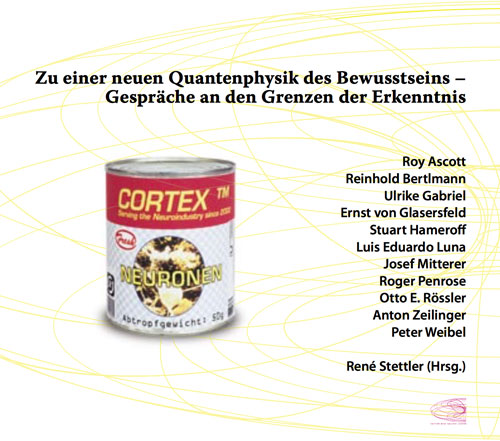
3 herausragende hochaktuelle Luzerner Gespräche aus dem Jahr 2001 (159 Seiten): Lesen Sie, welche kontroversen Ideen die beiden heutigen Nobelpreisträger
in Physik Roger Penrose und Anton Zeilinger zu einer neuen Quantenphysik des Bewusstseins öffentlich debattierten.
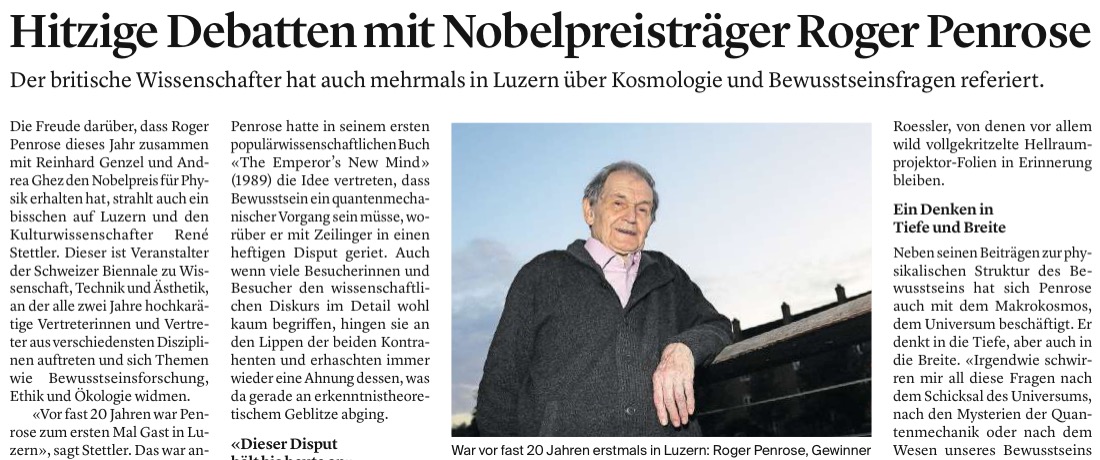
The British mathematical physicist Roger Penrose who spoke three times at the Swiss Biennial was awarded the 2020 Nobel Prize in Physics. He used ingenious mathematical methods in his proof that black holes are a direct consequence of Albert Einstein’s general theory of relativity. Einstein did not himself believe that black holes really exist, these super-heavyweight monsters that capture everything that enters them. Nothing can escape, not even light.
The Nobel Prize in Physics 2020 - Press release, 6 October 2020 "Hitzige Debatten mit Nobelpreisträger Roger Penrose", Pirmin Bossart, Luzerner Zeitung, S. 17, 17.10.20
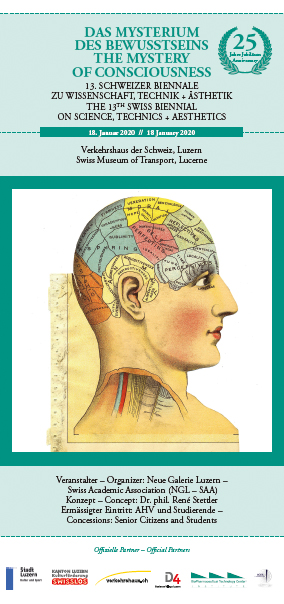
The Swiss Biennial 2020 "The Mystery of Consciousness" online
All the lectures and the panel discussion can be watched online (in English or German), and are available via art-tv.ch/biennaleluzern for CHF 50.00 (unlimited access). Send an e-mail to info at neugalu.ch. Mention your first and last name, address, city, country, phone number, and ask for the password. You will then be billed by e-mail (not by an automatically generated e-mail, but a personal e-mail), and the password will be sent to you once your payment has been received.
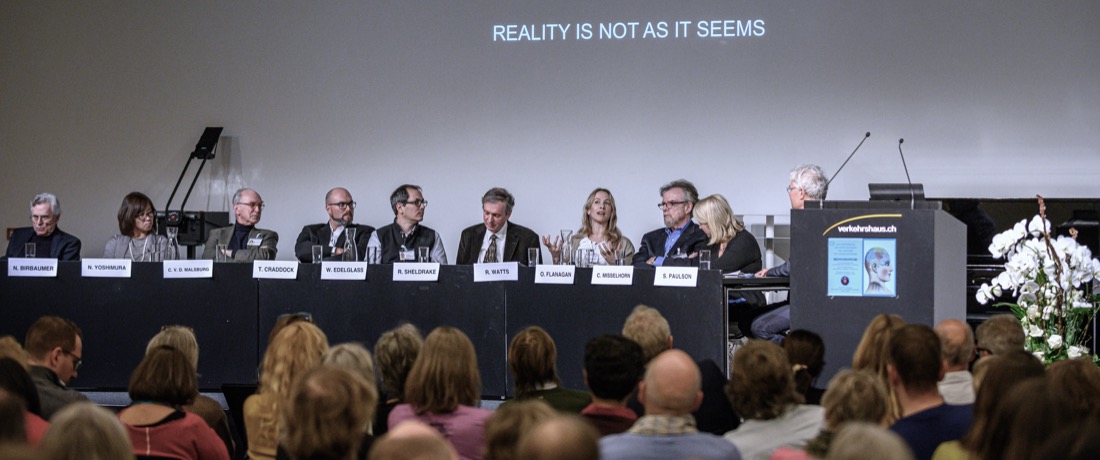
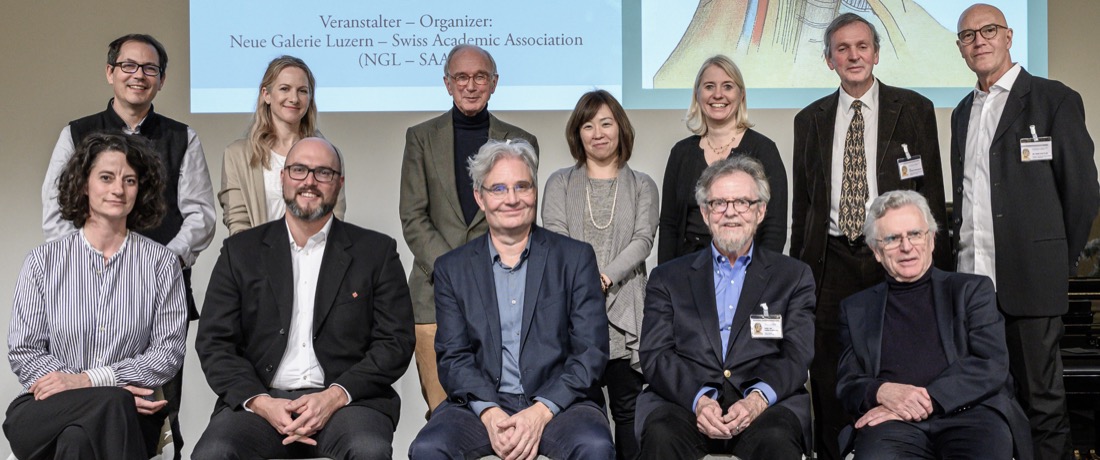
Picture below: Speakers and chairpersons of the Biennial 2020 "The Mystery of Consciousness" (Lucerne, 18 January 2020), from left to right: William Edelglass, Rosalind Watts, Christoph von der Malsburg, Natsue Yoshimura, Catrin Misselhorn, Rupert Sheldrake, René Stettler, Magaly Tornay, Travis Craddock, Steve Paulson, Owen Flanagan, Niels Birbaumer.
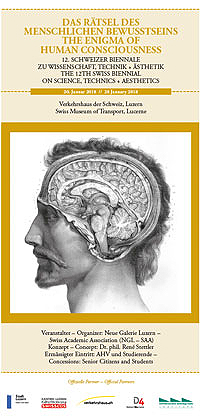
On 20 January 2018, renowned scientists such as the British astrophysicist and Astronomer Royal Martin J. Rees, the American cognitive scientist Donald D. Hoffman, the science writer and journalist John Horgan, the Brazilian physicist Marcelo Gleiser as well as B. Alan Wallace, the former Buddhist monk and representative of the contemplative sciences, gave public talks at the Swiss Museum of Transport on the occasion of the 12th Swiss Biennial on Science, Technics + Aesthetics. The subject they were addressing was The Enigma of Human Consciousness – Das Rätsel des menschlichen Bewusstseins.
Watch the Biennial 2018 lectures online!All the lectures as well as the panel discussion can be ordered for CHF 40.00. Language: English or German.
Order
Send an e-mail to info at neugalu.ch Mention your first and last name, address, zipcode, place as well as your phone number. You will be billed (pdf) in a personale-mail (not by an automatically generated e-mail to the sender). Once your payment has been received, the password will be sent to you via e-mail.
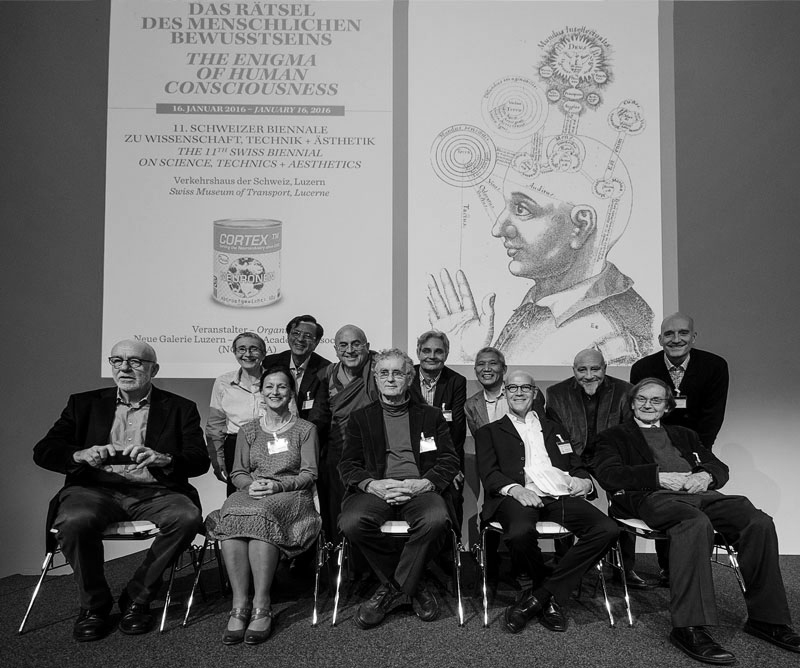
From left to right: Biennial 2016 speakers / chairpersons: Prof. Dr. Ernst Peter Fischer, Dr. Waltraut Liebl-Kopitzki, Dr. Fritjof Capra, Dr. René Stettler, Prof. Dr. Sir Roger Penrose, Dr. Friedericke Meckel, Dr. Luis Eduardo Luna, Dr. Matthieu Ricard, Steve Paulson, Dr. Thupten Jinpa, Dr. Stuart Hameroff, Diego Hangartner, Pharm.D.
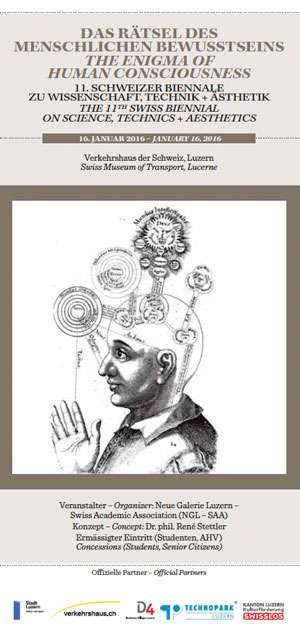
The 11th Biennial
Internationally acclaimed scientists such as the ecologist Fritjof Capra, the mathematician Sir Roger Penrose, the neurobiologist Christof Koch, the Dalai Lama’s longtime English interpreter, Thupten Jinpa, and the Buddhist monk Matthieu Ricard gave public talks in Lucerne.
All lectures are available as online videos via this link for
CHF 40.00 (unlimited access). Language: German and
English. Video above: Welcome Address, René Stettler,
16 January 2016.
Order
Send an e-mail to info at neugalu.ch. Indicate your name, address, phone number, and ask for the password to see all the online videos. You will then be billed and the password sent to you via e-mail.
On 18 and 19 January 2014, the 10th Swiss Biennial on Science, Technics + Aesthetics took place in the Swiss Museum of Transport. The Biennial created a platform for public discussion about climate change and environmental destruction and its consequences for humanity. It included speakers such as Jakob von Uexküll, Founder of the “Right Livelihood Award” and Initiator of the “World Future Council”. Free video access.
Swiss Museum of Transport, Lucerne. With top speakers from around the globe such as Fritjof Capra, Manfred Folkers, Thupten Jinpa Langri, Marion Neumann, Niko Paech, Jill Bolte Taylor, Margaret Wertheim.
Steve Paulson will moderate the big panel discussion. more.
Trailer (Youtube)
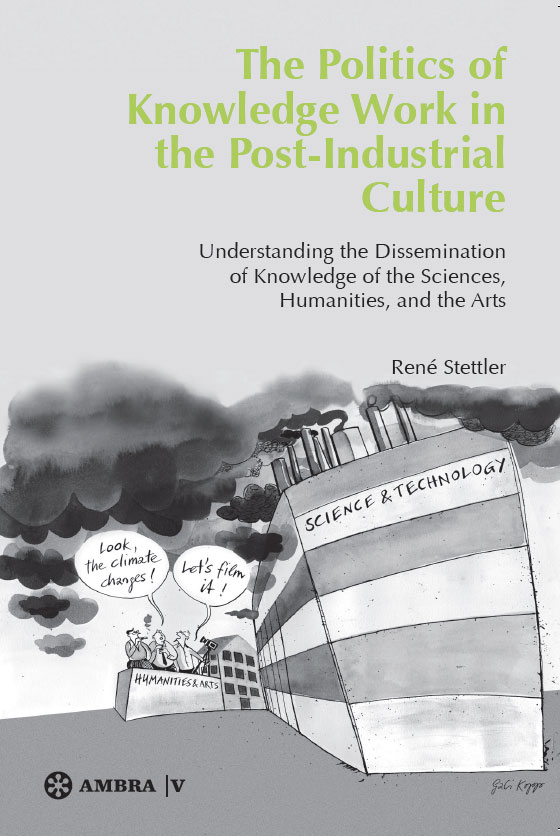
Book (2014)
The Politics of Knowledge Work in the Post-Industrial Culture


 After almost 30 years and 14 Swiss Biennials, we are no longer carrying out any more cultural and scientific projects. Funding has proved increasingly difficult in recent years - in particular after Corona. We very much regret this decision and thank you for your long-term loyalty.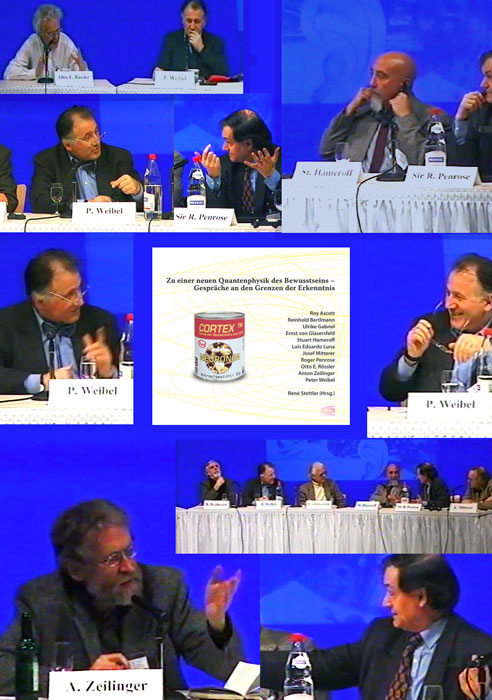
 If you have time to write a testimonial about the Biennial (1 -2 sentences), you can send it to us with your first name, surname, place of residence via info